
Hi-Secure Achieves IACS UR E27 Type Approval
## Overview
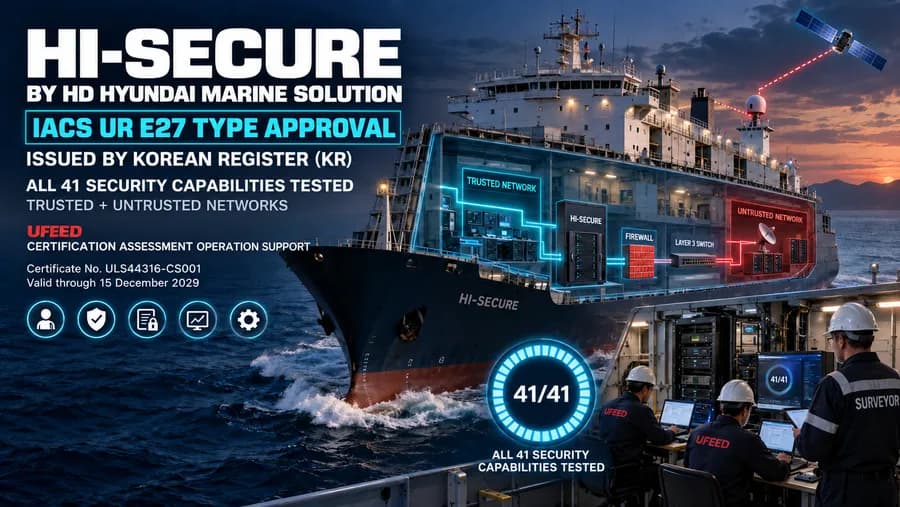
In December 2024, **Hi-Secure**, the maritime cyber resilience platform developed for HD Hyundai Marine Solution, obtained **IACS UR E27 Type Approval** (Certificate No. ULS44316-CS001) from Korean Register, valid through 15 December 2029. UR E27 defines the cyber resilience requirements for Computer Based Systems (CBS) installed on board ships, based on IEC 62443-3-3 and IEC 62443-4-1.
The approval covers Hi-Secure's full hardware and software stack — including its servers, firewalls, and Layer 3 switching components — for deployment in both **trusted and untrusted network** environments, meaning the platform was assessed against the complete requirement set defined in UR E27, not a reduced scope.
During the certification process, UFEED was directly responsible for operating the test equipment and executing the procedures across **all 41 security capability items** specified in UR E27, working hands-on alongside the class surveyor throughout the on-site assessment.
## What UR E27 Type Approval Means
Unlike UR E26, which evaluates cyber resilience at the whole-ship level, UR E27 assesses individual computer-based systems and equipment. Type Approval allows a product's security capabilities to be certified once, in advance, and then applied across multiple newbuildings with only a reduced set of vessel-specific documents — rather than repeating a full survey and factory acceptance test (FAT) for every ship. For a platform like Hi-Secure, built to be installed broadly across a growing newbuilding portfolio, this is what makes scalable deployment realistic.
## The 41-Item Assessment Structure
UR E27 organizes its required security capabilities into two tables, totaling 41 items:
**Table 1 — Required Security Capabilities (30 items)**, applicable to every CBS in scope, grouped by security objective:
- **Access control & authentication** (Items 1–7): human user identification/authentication, account and identifier management, authenticator management, wireless access authentication, password strength enforcement, authenticator feedback obscuring
- **Use control** (Items 8–16): authorization enforcement, wireless use control, portable/mobile device restrictions, mobile code control, session locking, auditable events, audit storage capacity, audit failure response, timestamping
- **System integrity** (Items 17–20): communication integrity, malicious code protection, security functionality verification, deterministic output under attack conditions
- **Data confidentiality** (Items 21–22): information confidentiality, use of cryptography
- **Monitoring & response** (Item 23): read-only audit log accessibility
- **Resource availability** (Items 24–30): denial-of-service protection, resource management, system backup, recovery and reconstitution, alternative power source handling, network/security configuration interfaces, least-functionality enforcement
**Table 2 — Additional Security Capabilities (11 items)**, applicable specifically to CBSs with connectivity to untrusted networks:
- Multifactor authentication for remote human users
- Software process and device identification/authentication
- Limits on unsuccessful login attempts
- System use notification banners
- Monitoring and control of access via untrusted networks
- Explicit on-board approval required for external access
- Automatic/manual remote session termination
- Cryptographic integrity protection for untrusted-network communication
- Input validation for externally sourced data
- Session integrity protection
- Invalidation of session IDs after logout
Because Hi-Secure's approval scope explicitly includes both trusted and untrusted network operation, all 41 items — not just the base 30 — were in scope for the assessment.
## UFEED's Role: Operating the Assessment
For each of the 41 items, UFEED configured the live test environment against the approved test procedure documentation, executed the defined test steps on the actual Hi-Secure system, and presented results directly to the attending class surveyor for real-time witnessing — the model required under UR E27 section 6.3.2, where security capability tests must be "witnessed/accepted by the class surveyor."
This in-person, item-by-item operational approach allowed ambiguous or borderline results to be clarified and re-tested on the spot, which shortened the overall assessment cycle and reduced the risk of open findings requiring a follow-up site visit.
## Why It Matters
Hi-Secure has since gone on to obtain UR E27 approval from **six classification societies** and has been deployed across roughly 50 vessels built at HD Hyundai Heavy Industries, HD Hyundai Mipo, HD Hyundai Samho, and HD Hyundai's Philippine shipyard, supported by a standing supply agreement covering newbuildings across the HD Hyundai group. This Type Approval was an early, foundational milestone in that track record: it demonstrated that Hi-Secure's security architecture could withstand full item-by-item scrutiny under IEC 62443-based requirements, under live operating conditions — not just on paper.
For UFEED, running the complete 41-item assessment firsthand also built a repeatable internal methodology for UR E27 testing, one that has since informed how subsequent Hi-Secure releases and certifications are prepared for classification review.
- maritime-cybersecurity
- IACS-E27
- Hi-Secure
- Type-Approval
- Cyber-Resilience
- IEC-62443